Author name: admin

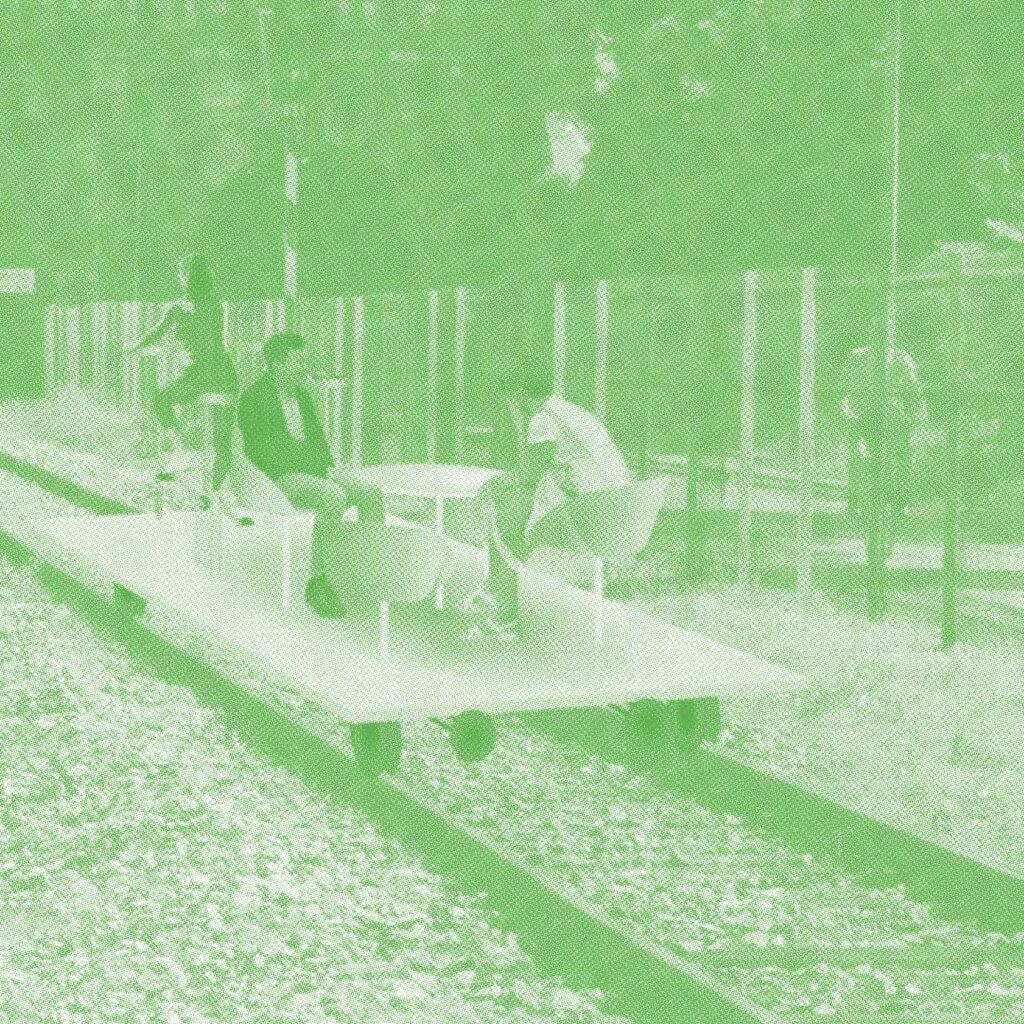
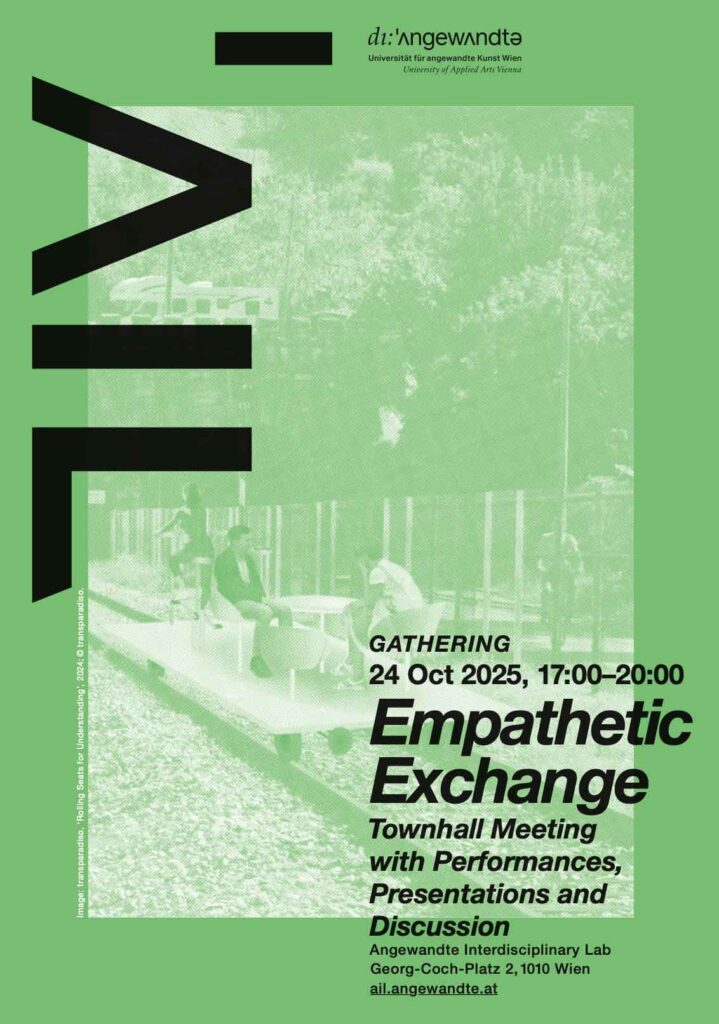
Townhall Meeting: Empathetic Exchange, 24 Oct 2025, 17:00

An evening of discussions and performances (17:00–20:00)

With contributions by: 

Mel Jordan (Coventry University) and Andrew Hewitt (University of Northampton), leaders of SPACEX; Jitka Hlavačková (Prague City Gallery/ GHMP, Prague), Susanne Prinz (Kunstverein am Rosa-Luxemburg-Platz, Berlin), Vittorio Iervese (Università di Modena, Modena), Aline Hernandez/ Marianna Takou (CASCO Art Institute, Utrecht); Annette Krauss (University of Applied Arts Vienna), Julienne Lorz (University of Applied Arts Vienna), Barbara Putz-Plecko (University of Applied Arts Vienna / former Head of the Dept. Art and Communicative Practice), and others.

Moderation: Kathrin Wildner (urban ethnologist, metroZones, Berlin).

Event programme (PDF)

Event website

Event information (PDF)

Townhall Meeting: Empathetic Exchange, 24 Oct 2025, 17:00 Read More »

Living Better Together: SPACEX conference, 13th & 14th November 2025

Living Better Together conference concludes the Spatial Practices in Art and ArChitecture for Empathetic EXchange (SPACEX) project; a cross-continental and cross-disciplinary effort bringing together academics and cultural organisations to build stronger networks and maximise the ways in which art, architecture and design promote empathetic ways of living together.

Thursday, November 13, 9:30am – 6pm GMT
Friday, November 14, 9am – 6pm GMT

Book tickets: Day one, Day two

Herbert Art Gallery & Museum
Jordan Well Coventry CV1 5QP
The Herbert Art Gallery & Museum is wheelchair accessible, further information on accessibility can be found on their website.

This event is free to attend, booking essential, donations welcome.

Day one

Publishing in the Counterpublic Sphere interrogates how spatial practice of art, design, film and architecture can create counterpublic spheres where participants mobilise collective discourses of imagination, care and resistance to resist neoliberal and authoritarian rationales.

Walking as Resistance examines the role of walking practices as critical spatial practices that can address social, geopolitical and environmental issues, support spatial justice, engage in multi-sensory experiences of the everyday, and amplify unheard stories.

Spaces of Knowledge examines the role of urban walking as a methodological approach to foster social change and policy development.

PhD Experiences shares the experiences of being PhD students within the SpaceX consortium and how the secondment process informed and supported our research.

Introduction to the Marie Skłodowska-Curie Actions (MSCA) Staff Exchanges initiative is an opportunity for attendees to ask questions about the funding call and project delivery processes.

Day two

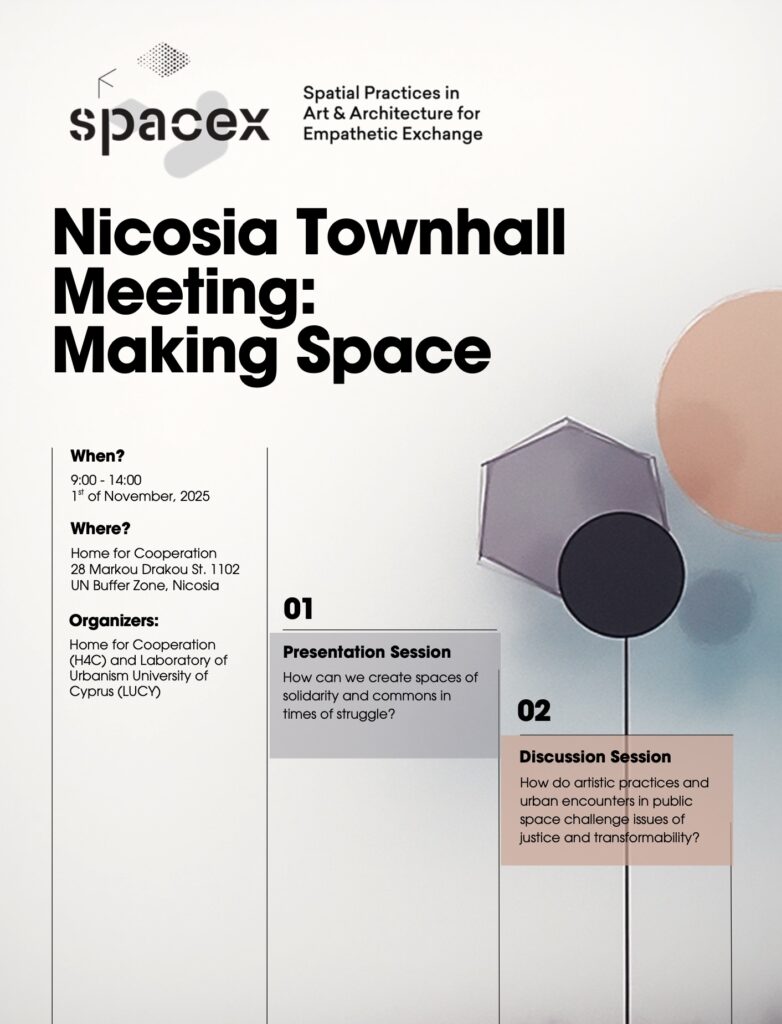
Town Hall Reporting introduces dissemination events in Austria and Cyprus designed to communicate spacex activities with a wider audience and extend discussions to a specific locale.

The Digital Counterpublic Sphere interrogates the challenges these technological developments have given rise to, including surveillance, AI, and the manosphere.

Unsettling Institutions responds to a cultural context increasingly shaped by neoliberal and authoritarian value systems, and tests alternative approaches centred on collectivity, care, and commoning.

Gaming the System: Understanding the role of games in creating generative and empathic spaces of exchange explores ‘serious’ game design as a creative participatory practice that fosters discussion and engagement with social and spatial justice issues while exploring creative solutions to these challenges. 

Gameplay Event: CRITICAL URBAN PLAY: SOLIDARITY WITH PALESTINE, invites you to play one of the serious board games designed by students at the Department of Architecture, University of Cyprus, during 2023-2024.

Living Better Together: SPACEX conference, 13th & 14th November 2025 Read More »

Jamila Squire

MayDay Rooms, London

Jamila is a member of the MayDay Rooms collective – an archive dedicated to the history of social struggles, resistance campaigns and experimental culture. The main work of MayDay Rooms consists in connecting historical materials with contemporary political struggles through collaborative education, informal research, digitisation and free distribution. During her SPACEX secondment she will be researching a project on Italy’s autonomia movement, its experiments in collective living and subsequent state repression that culminated in international solidarity conferences in Bologna 1977 and Padova 1984. 

Maydayrooms.org

Secondment destination
UNIMORE, Modena, May 20 2025

Jamila Squire Read More »

Dr Fiona Whelan at Home for Cooperation, Nicosia

13 Jan 2023 (8 days)
24 March 2023 (11 days)
11 Jan 2024 (8 days)
17 March 2025 (6 days)

Focused on work package 3 ‘Urban Subjects’, I have used the two research questions to guide me in my interactions:

  • How do the pedagogic strategies employed by spatial practices effect and contribute to the transformation and construction of subjectivity? 
  • What forms of knowledge are produced, and what types of subjects are supported? 

I have broken the secondment into 4 visits, recognising my own subjectivities elicited in context, and shifting familiarity with the context through each trip and investment in relationships, while exploring the above questions.

The methods I have used are:

  • Walking / drifting
  • Meetings with a range of people from arts, education, and community projects
  • Informal conversation
  • Notetaking
  • Writing
  • Drawing
  • Photographing
  • Reading 
  • Visiting Museums and cultural centres
  • Attending events
  • Working on adjudication panel for arts funding

My intention by the Nov 2025 conference is to produce a small booklet combining image and text. A limited number of these would be produced, and subsequently gifted to sites I inhabited during my trips and to key people I met. 

In terms of the conference, I would propose giving a ‘performed’ presentation that would bring this booklet alive – a combination of reading passages with projected visuals. 

Dr Fiona Whelan at Home for Cooperation, Nicosia Read More »

Chiara Valci Mazzara at Academy of Fine arts/ Akademie výtvarných umění v Praze , U akademie 172/4, Prague, Czech Republic.

View from Intermedia II – Studio Sceranková and Zahoranský – AVU Prague

24-31 January 2023
12-18 January 2024
19-24 March 2024
10-17 June 2024
22-29 October 2024

Host: Prof. Mgr. art. Dušan Zahoranský – Intermedia II – AVU

From the very first days in the city, I have been introduced by Dušan Zahoransky to Prague’s urban tissue, cultural landscape and art scene; we dedicated several meetings to sharing ideas and objectives in relation to the outcome of my secondment, to the WP2 and 4 and to the program of Intermedia II. I regularly visited major art institutions, galleries, project and independent spaces, experimental hubs, artists studios and the graduation shows at AVU, Famu and Umprum. Although initially my focus was on mapping and understanding how the cultural offer –  specifically how projects, performances, talks, round tables, panels, institutional shows and diploma exhibitions – was communicated ,  I further extended my research to the ways in which artists and art students were communicating their process, research and final work. The outcome has been a day in which I held a workshop in the form of a conversation, an active dialogue, with the students focused on two main topics of discussion and exchange: the artist studio as an archive and how to communicate it and the empathetic forms of communication of the artistic process.

In addition, previously, I had the chance to review various portfolios in October 2024 and to support as a guest critic reviewing the work of many graduates on the occasion of the diploma show at AVU in June 2024.

Chiara Valci Mazzara at Academy of Fine arts/ Akademie výtvarných umění v Praze , U akademie 172/4, Prague, Czech Republic. Read More »

Denise Ziegler at Academy of Fine Arts at the university of the Arts Helsinki

Ziegler, D. Colour Fields (2024). [Series of paintings] Squeesed urban wildflower heads on paper. Left: small purple flower, right: buttercup. Location: Meadow behind the Irish Museum of Modern Art 23.6.2024.© Denise Ziegler
Ziegler, D. Painting with the Subway (2024). [Series of Paintings]. Painting made in collaboration with the Subway trains. ©Denise Ziegler

Denise Ziegler at Academy of Fine Arts at the university of the Arts Helsinki Read More »

K. Yoland at Kunstverein am Rosa-Luxemburg Platz, Berlin, Germany

Hung up to dry, K. Yoland, 2023, in the exhibition <Exit is No Object>, KHSB Berlin-Karlshorst, 2023 © photo: K. Yoland

1st part: 15 October – 24 October 2022 (10 days)
2nd part: 2 May – 22 May 2024 (21 days)

I used the secondment to explore territorial zoning and control in the former Russian occupied East Berlin. The residency allowed me to research my interests in “spatial control” in a new context — out of the desert and in an urban and historical context. I explored the architecture/infrastructure of prisons and urban-scale militarised containment and surveillance of populations. Additionally, I developed a site-specific installation examining the history and spaces of imprisonment. At the end of the residency Kunstverein invited me to present a performative reading of my previous Desert observations — an exploration of militarised power and control across invisible lines in the sand. I am grateful to Dr Jaspar Joseph-Lester for nominating me as a researcher and for Susanne Prinz and Dr. Chiara Valci Mazzara for inviting me to perform a reading (Desert Diaries) at their gallery and for introducing my work to the curator, Elana Katz (of House of the End of the World) who curated me in EXIT IS NO OBJECT

“Hung up to dry”, March, 2023

Site-specific installation in a former KGB prison in Berlin-Karlshorst, March, 2023. All those brought to the prison in East Berlin were then transported to work camps in Russia or Crimea. The title and inspiration for the work orginates from the phrase ‘hung up to dry’. While wet clothes can be hung up to dry, when the term is applied to a person, it means they were punished or made to suffer unjustly, without recourse to support or defence. In the room, the hanging materials speak to the people and bodies whose futures were forcefully removed. The installation was only accesible for an audience via a security camera. Fans were used off-camera to move the hanging material, evoking tension, wind, invisible forces or the ghost traces of unresolved tragedies.

K. Yoland at Kunstverein am Rosa-Luxemburg Platz, Berlin, Germany Read More »

Jaspar Joseph-Lester at Transparadiso, Vienna

Part 1: 30 March – 10 April 2022 (12 days)
Part 2: 26 Nov – 3rd Dec 2022 (8 days)
Part 3: 9 May – 21 May (11 days)

My secondment with Transparadiso was split into three. The first trip involved an introduction to the interpapillary practice of Transparadiso and a trip to Chemnitz (2025 City Culture) where I was able to develop a proposal for Barbara Holub’s flagship project WE PARAPOM. As part of the research, I was invited to join city walks, screenings, plantings and talks that Holub had curated in Chemnitz. These events and activities gave me a deeper insight into the potential for developing an art project that could address some of the issues facing Chemnitz. I developed a proposal ‘The Chemnitz Pavilion’ in the period leading up to the second trip. The proposal was accepted by Holub and received funding (production costs only) from the City of Culture. I worked with participants (residents from the city) to develop a series of co-designed location-based stickers. The Chemnitz Pavilion stands as three distinct figures: The Pavilion, The Stickerbook and The City Guide. Put simply, we can describe the Pavilion as a conceptual construct, the stickerbook as a material output and the city guide as a supplementary addition

It is clear to anyone that visits Chemnitz that a particular proliferation of stickers is in operation. Moreover, there is a battle between these mobile and ephemeral modes of communication. Throughout my time in Chemnitz, I encountered oppositional ideological messages played out through the constant stickering and re-stickering of shared public space. In short, the Chemnitz Pavilion aims to emancipate the sticker from the type of use that serves the ideological interests of political extremism. Through the secondment I explored the question of how the sticker has the potential to create a sense of spatial belonging for communities and individuals that inhabit the city.

Jaspar Joseph-Lester at Transparadiso, Vienna Read More »

Dr Tom O’Dea at Van Abbe Museum, Netherlands

July 2023, June 2024

The initial proposal for my secondment was to connect with Eindhoven’s positioning as a “smart” and “tech” hub. This positioning reflects Eindhoven’s move from an industrial centre built around electronics company Philips manufacturing to a post-industrial one based around Philips design and high-tech semiconductor manufacturing in (Philips owned) ASML. This economic positioning mirrors, in some ways, that of Dublin – which position itself also as a hub of tech companies and of Ireland as a major semiconductor manufacturing centre – however without the history of major manufacturing, large communities of migrant workers and from opposing positions in the relationship between coloniser and colonised. These similarities are also reflected in an increasingly stressed housing situation in which high-paid workers, under-regulated private rental accommodation and financialised housing development have begun to displace and inhibit rental for lower paid communities. Framed as a part of my Department of Embedded Knowledge project – the project intended to explore the “other” forms of innovation and “smartness” that exist within communities that are not captured in the narratives of The Smart City. In particular, the intention was to focus on practices of resilience, self-organisation and mutual support that allow communities under threat from capital to find ways to resist and survive the forces of global capital.
Having spent some time within the Van Abbe museum and with the curatorial team the project took an alternative direction based on the museum’s development of “constituent” practices – that sought to bring different communities into the museum as active participants in the museum programme. In particular, through work with the constituent archivist, the project began to focus on the way in which the museum’s archive would need to adapt to take on board the types of knowledge and knowledge communities that the constituent approach would involve.
In order to do this – the proposal became to work with one such constituent group to carry out a workshop to understand what knowledge would be archived and why. This work was planned for the second part of the secondment. Unfortunately, due to illness, the curator with whom I was working became unavailable for the second part of the secondment and so the workshops were not possible to achieve in the programmed time.

Dr Tom O’Dea at Van Abbe Museum, Netherlands Read More »

Scroll to Top